Lever & Steam is not a dealer, importer or service agent for any tamper maker. For warranty, parts or repairs on an automatic tamper, contact the business you bought it from or the maker. Brand names here only describe products.
How an automatic tamper works
You grind into the portafilter, put it into the tamper's cradle, and a motor presses a tamping disc onto the coffee at the selected force, then lifts it. Consistency depends on correctly matching the disc, holder and portafilter, as well as maintaining the unit; automation does not correct a badly fitted setup.
The best-known units are made by Puqpress (models such as the Q2 and M2 are common in Australian cafés). Specifications published by Australian and overseas retailers list an adjustable pressure range of about 5 to 30 kg in 1 kg steps, and a choice of tamp profiles. Other makers build similar machines, and several grinder makers now build tamping into the grinder itself.
Setting one up
- Match the disc to your basket. The tamping disc must suit your basket's diameter (most cafés run 58 mm; check the tamper size chart). Many units take interchangeable discs.
- Set the portafilter height. The cradle or holder is adjusted so your portafilter sits flat and the disc meets the coffee squarely. Spouted and bottomless portafilters may need different settings or holders. Follow your unit's manual; the adjustment is usually a screw or a spacer.
- Set the pressure. Start in the middle of the range (around 15 to 20 kg is a common starting point) and adjust with your grind, not instead of it. Pressure changes the shot far less than grind size does.
- Choose a profile, if your unit has them, using the maker's description of what each does. Check the resulting shot rather than assuming a particular profile suits every light roast, then dial in your grinder as usual.
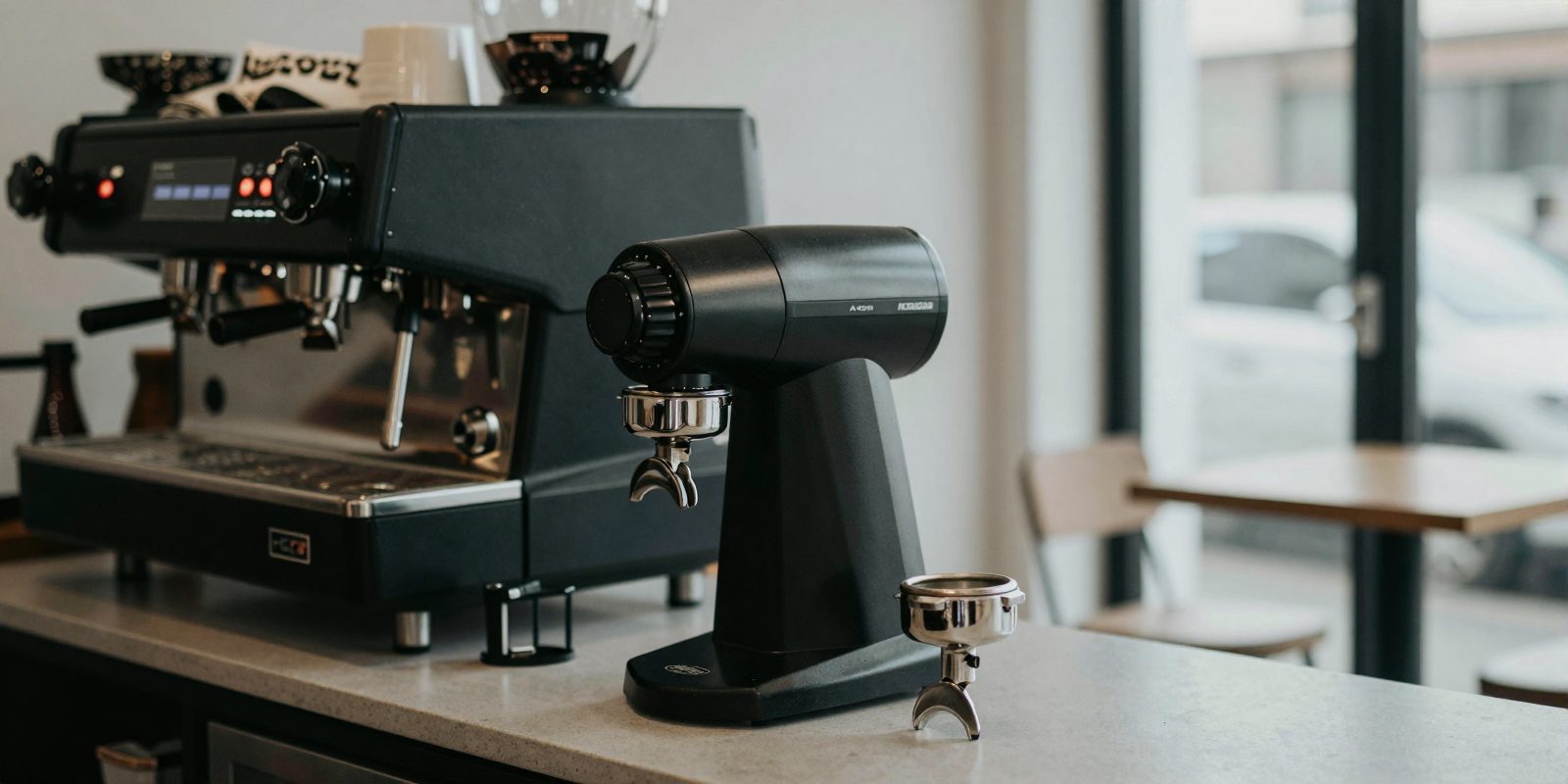
- Place it. Put the tamper beside the grinder on the barista's side, on a stable, level surface, so the workflow is grind, tamp, lock in without turning around.
Types of automatic coffee tamper
Three kinds of machine take the pressing out of a barista's hands.
- Standalone automatic tampers. A separate unit that sits beside the grinder. You place the portafilter in the cradle and the machine tamps. This is the most common type in Australian cafés and works with almost any grinder.
- Grinder-integrated tamping. Some commercial grinders now grind and tamp in one step, so the portafilter comes off the grinder ready to lock in. It saves bench space and one handling step, but ties your tamping to that grinder.
- Semi-automatic and calibrated hand tampers. Not motorised, but they click or stop at a set force, or level themselves on the basket rim. They are the budget middle ground between a plain hand tamper and an automatic one.
Prepare the coffee bed first
An automatic tamper presses whatever is in the basket. If the grounds are piled to one side, the tamp will be level but the coffee under it will not be even, and the shot can still channel. Keep the steps before the tamp tidy:
- Grind into the centre of the basket, rotating the portafilter if the grinder throws coffee to one side.
- Break up clumps with a needle distribution tool, or settle the bed with a gentle tap.
- Use a distribution tool set to the right depth, if you use one, so the bed is flat before it reaches the tamper.
- Tamp, then lock in and start the shot promptly.
Dialling in with an automatic tamper
Once the tamper is set, leave it alone and dial in with the grinder, as you would with a hand tamper. Set your dose, set the pressure once, and change the grind to hit your shot time and taste. If you change the pressure, change nothing else for the next few shots so you can see its effect. Most cafés settle on one pressure setting for all their espresso and never touch it again, because the gain from consistent tamping comes from it being the same every time.
Checking the setup is right
After setup, and every few weeks, check that the tamp is doing what you expect.
- Look at the puck. After a shot, the spent puck should be flat and even, without a deeper ring at the edge or a slope across it.
- Check the depth. With the same dose, the coffee should sit at the same depth in the basket each time. A tamp that sits lower on one side means the portafilter is not seated level.
- Watch a bottomless portafilter. If you have one, pull a shot and watch the bottom of the basket. Even, central flow means even tamping and distribution; a spray or a single jet from one side means something is uneven.
Common faults and what to check
| What you see | What to check |
|---|---|
| Tamp is not level | Portafilter holder height and seating; the right holder for spouted or bottomless portafilters |
| Coffee left around the edge | Disc too small for the basket; check the basket's real internal size |
| Disc catches on the basket | Disc too large, or a tapered basket; check the maker's recommended disc |
| Shots still run unevenly | Distribution before tamping, grind clumping, a worn basket |
| Unit does not start | Power, the cradle sensor, and the maker's error guide |
| Grounds stuck to the disc | Clean the disc as the manual permits; very fine or oily coffee sticks more |
If the fault persists, contact the seller or the maker's service agent rather than opening the unit.
Buying one: what to check
- Basket and disc sizes. Confirm the unit supports your basket diameter, and whether discs are interchangeable if you run more than one size.
- Portafilters. Check it fits your portafilter style, including spouted, bottomless and any brand-specific handles.
- Pressure range and steps. A wide adjustable range with fine steps gives room to match your coffee.
- Speed. The time per tamp matters in a busy morning rush; ask to see one working.
- Size and noise. Measure the bench space beside your grinder.
- Electrical compliance and service. Electrical equipment sold in Australia should carry the Regulatory Compliance Mark (RCM). Ask who services the unit locally and how fast parts arrive.
- Warranty. Check what it covers in commercial use and for how long.
Training baristas to use one
An automatic tamper takes minutes to learn, but a few habits keep it accurate. Show staff how to seat the portafilter fully in the cradle, how to keep the disc and cradle free of grounds through the shift, and not to press down on the portafilter while the tamper runs. Write the pressure setting and the cleaning routine on a card beside the unit so every shift runs it the same way.
Automatic coffee tamper for home use
A few home baristas buy automatic tampers for consistency or because of hand and wrist pain. If that is you, weigh the cost against a good calibrated or self-levelling tamper, which solves most home tamping problems for far less. If pain is the reason, an automatic tamper can genuinely help; speak with a health professional about the cause too.
Daily cleaning
Coffee grounds build up on the disc and in the cradle. Follow the model's cleaning instructions: some units use a powered cleaning mode to position the disc, while other cleaning steps require the unit to be disconnected. Keep hands clear of a moving disc and do not improvise between those modes. Use only the cleaning tools and moisture level the maker permits; never spray water into the unit or wash it under a tap.
Running costs beyond the purchase price
The price on the quote is only part of what an automatic tamper costs. Budget for:
- Spare discs if you run more than one basket size, or a second disc so one can be cleaned while the other works.
- Holders or spacers for different portafilters.
- Servicing on the maker's schedule, and travel or freight to the service agent if there is none in your town.
- Downtime. Keep a good hand tamper on the bench as a backup, so a fault never stops service.
Set these against what it saves: fewer remade coffees from uneven shots, faster training of new baristas, and less strain on staff.
A tamping station that works in a rush
In a busy café the best layout puts the grinder, the tamper and the group heads in one short line, so the barista grinds, tamps and locks in without turning or walking. Put the tamper on the side of the grinder closest to the machine, at the same bench height, with the knock box just beyond it. Keep a clean dry cloth within reach for wiping the basket rim before the portafilter goes in. With two grinders (house blend and decaf), place the tamper between them so both share it.
Weekly care beyond the daily clean
Once a week, with the unit off and unplugged as the manual directs, check the disc for nicks or a build-up of coffee oil, check the cradle and holder for wear, and wipe the body and the bench underneath it. Coffee oil turns rancid and sticky over time, and a sticky disc lifts grounds off the puck. Use only the cleaning products the maker approves; some recommend a dry brush only, others allow a lightly damp cloth on the disc. Food businesses should include the tamper in their written cleaning schedule alongside the grinder and the espresso machine, so it is cleaned at the same time and nobody skips it on a busy day. A tamper looked after this way should keep tamping evenly for years.
Manual versus automatic
Hand tamper
- Cost
- Tens of dollars to a few hundred
- Consistency
- Depends on the barista
- Level
- With practice, or a self-levelling base
- Speed
- Fast for a skilled barista
- Strain
- Repetitive wrist and shoulder load
Automatic tamper
- Cost
- Usually over a thousand dollars
- Consistency
- Same pressure every shot
- Level
- Every time
- Speed
- A second or two per shot
- Strain
- Removes the pressing motion
Tamping and wrist strain
In a busy café a barista may tamp hundreds of shots a day, each with a twist and a downward press through the wrist. Repetitive, forceful hand and wrist movements are a recognised category of hazardous manual task under Australian work health and safety law, and employers are expected to reduce the risk where they reasonably can. Removing the pressing motion is one of the reasons cafés buy automatic tampers. This is general information, not medical advice: anyone with wrist or hand pain should see a health professional.
Is one worth it?
- A café pulling a few hundred shots a day or more: often yes. Consistency across baristas and shifts, less strain, and one variable taken out of dialling in.
- A small café or cart: a calibrated or self-levelling hand tamper gets most of the consistency for a fraction of the cost.
- At home: rarely. A good self-levelling tamper in the right size is the better spend; put the difference toward a grinder.
Common questions
What is the best automatic coffee tamper in Australia?
The best-known units in Australian cafés come from Puqpress, and grinder makers increasingly build tamping into grinders. The right choice depends on your basket size, portafilters and volume; check that the unit supports your basket diameter and that local service is available.
Is a self-levelling tamper worth it?
Yes, especially while learning. It removes the most common tamping mistake, an uneven tamp, for little money.
What is the best affordable tamper for coffee?
A stainless self-levelling or calibrated tamper in the exact size for your basket. Size and level matter more than brand.
What pressure should an automatic tamper be set to?
A middle setting is a common starting point. Pressure changes extraction much less than grind size; set it once and adjust the grinder to dial in.
Do automatic tampers fix channelling?
Not on their own. They make the tamp level and consistent, but uneven distribution or clumpy grounds can still channel. Prepare the bed before tamping.
Can an automatic tamper be used with a bottomless portafilter?
Usually, with the right holder or height setting. Check the maker's list of supported portafilters before you buy.