Check your manual first. Use a blind basket only where the maker specifically allows backflushing. A three-way valve alone is not permission to improvise a cleaning routine. Follow the model's approved cycle and cleaner. Owners of Breville machines: see how to clean a Breville.
Every day
- After each shot, knock out the puck, rinse the basket and wipe it dry, and run a two-second flush through the group head to wash off loose grounds.
- After each milk drink, purge the steam wand, wipe it, and purge again.
- At the end of the day, brush around the group gasket and shower screen with a group brush, then do a water-only backflush (below, without the tablet) if your machine allows it. Empty and rinse the drip tray.
Backflushing with a cleaning tablet
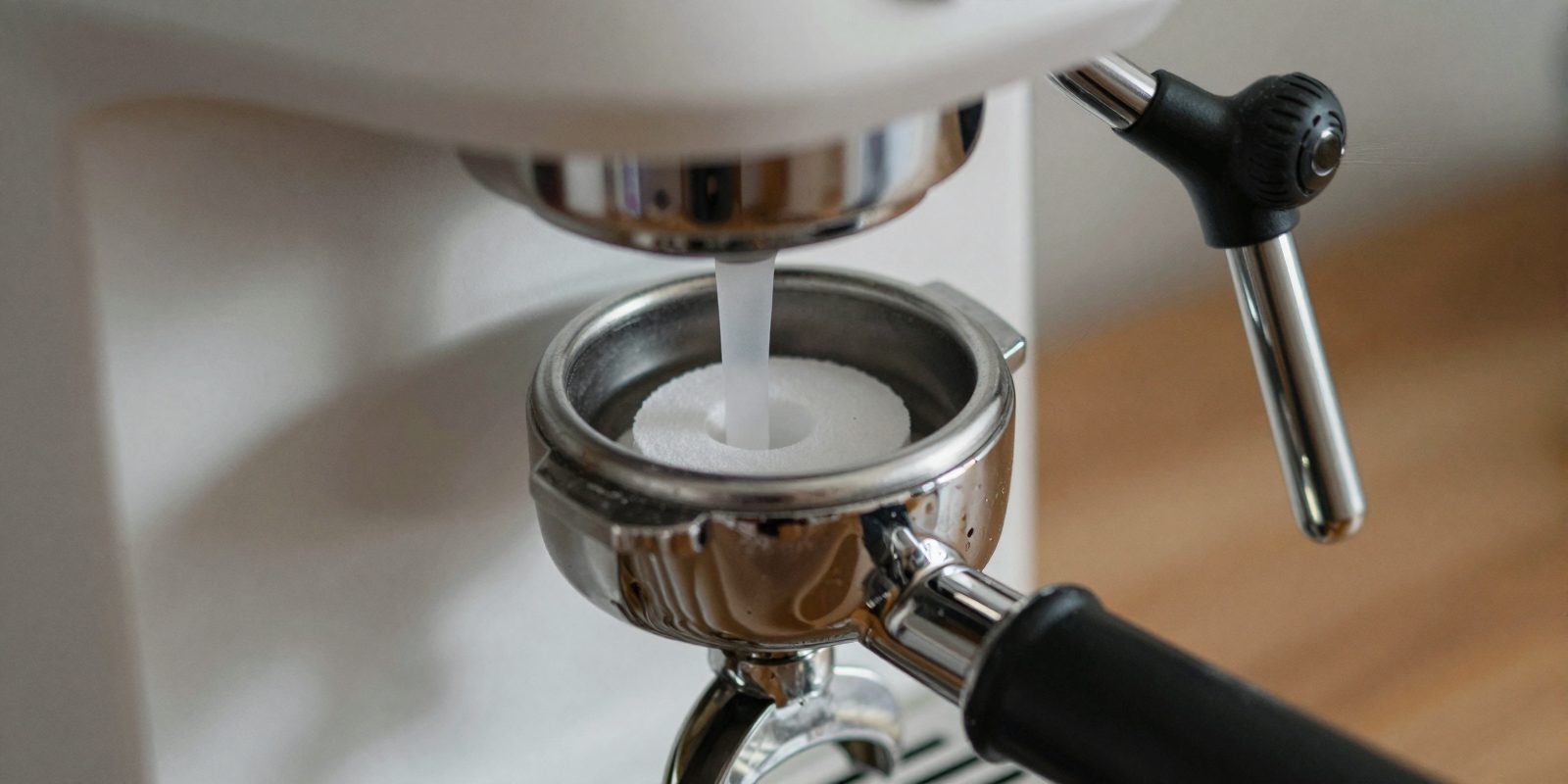
A backflush pushes water and cleaner back through the group head and out the three-way valve, dissolving the coffee oil that builds up inside. Cafés do it daily; at home, once a week to once a month depending on how much coffee you make. These steps follow the instructions Australian maker Cafetto publishes for its Espresso Clean tablets; your tablet's own instructions take priority.
- Swap the coffee basket for a blind basket (one with no holes). Put one cleaning tablet in it and lock the portafilter in.
- Run the pump for 10 seconds, then stop for 10 seconds, so the tablet dissolves and the cleaner soaks.
- Repeat four more times: 10 seconds on, 10 seconds off.
- Remove the portafilter and rinse it well.
- Lock it back in (blind basket, no tablet) and rinse: 5 seconds on, 2 seconds off, ten times.
- Put the coffee basket back and pull one shot to waste before you drink anything.
Soak portafilters and baskets in hot water with a dissolved tablet now and then (keep plastic and wooden handles out of the solution).
The water tank and cleaning kit
Empty and rinse a removable water tank as the manual directs. Do not put a group-head cleaning tablet into it: a tablet for coffee oil and a descaler for the water circuit serve different purposes. Keep a separate cloth for the steam wand, use a group brush where permitted, and check the basket, cleaning disc or blind filter specified for your machine. Follow the maker's instructions about dishwasher use and compatible chemicals.
Group gasket and shower screen
The gasket seals the portafilter against the group head. Leaks can come from dirty sealing surfaces, an overfilled basket or a worn gasket; check before replacing parts. Inspect the shower screen and gasket on the maker's schedule rather than replacing both automatically each year. Let the machine cool before handling these parts, and use a technician where the manual calls for service.
Descaling machines other than Breville
How you descale depends on the machine.
- Thermoblock and thermocoil machines (most compact home machines, De'Longhi Dedica, many automatics): use the maker's descaler and the machine's descale program, as the manual describes.
- Single-boiler machines such as the Gaggia Classic and Rancilio Silvia: makers publish a descale routine with a dedicated descaler run through the group and the steam wand, then a thorough rinse. Follow it closely; a bad descale can leave scale flakes in valves.
- Heat-exchanger and dual-boiler machines: many makers and technicians advise against home descaling, because loose scale can block valves and solenoids. The usual approach is to prevent scale with filtered or softened water, and to have a technician service the machine.
How fast scale builds up depends on your water: Adelaide, Brisbane and parts of Perth have moderately hard to hard water, Melbourne, Hobart and Sydney soft. Our city table has the figures.
Espresso machine cleaning powder or tablets?
Both do the same job: a detergent made for espresso machines that dissolves coffee residue and oil. Tablets are pre-measured, which makes home cleaning simple. Espresso machine cleaning powder is measured by the scoop, costs less per clean, and is what most cafés use for backflushing and for soaking portafilters, baskets and the drip tray. Use only cleaning products made for espresso machines; dishwasher detergent and household cleaners can damage seals and leave residue in the coffee.
Cleaning the steam wand and milk system
Milk is the part of your coffee machine that goes off fastest. Purge the wand before and after every jug, and wipe immediately with a damp cloth kept only for the wand, before milk bakes onto the hot steel. If milk has dried on, wrap the tip in a cloth soaked in hot water for a minute, then wipe. Once a week, unscrew the steam tip if your machine allows it and clear the holes with the small pin or brush supplied. Soak the tip in a milk-system cleaner made for coffee machines if the holes stay blocked.
Automatic machines with a milk jug or milk tube need the maker's milk-clean program, usually daily, and the jug and tubes hand washed in warm water and detergent. A milk system that is not cleaned smells sour and can grow bacteria.
Bean-to-cup and capsule machines
- Bean-to-cup automatics have a removable brewing unit on many models. Rinse it under warm water weekly, let it dry, and run the cleaning tablet program when the machine asks. Empty the grounds bin and drip tray daily.
- Capsule machines such as Nespresso models need little cleaning, but the capsule container, drip tray and water tank still need a wash, and the descale program when the machine prompts. Run a water-only cycle without a capsule now and then to flush the outlet.
Clean your coffee machine step by step: a weekly routine
- Run a cleaning tablet backflush, if your machine allows it.
- Remove the shower screen if it comes off easily, and scrub it and the group head with a cleaning brush.
- Soak the portafilter basket and spouts in hot water with cleaning powder for 20 minutes, then rinse.
- Wash the drip tray and grate in warm soapy water.
- Clean the steam tip as above.
- Wipe the outside, the cup tray and the water tank.
- Brush out the grinder chute and wipe the hopper.
- Pull a shot to waste and taste the next one.
Signs your espresso machine needs cleaning
- Coffee tastes bitter, ashy or stale even with fresh beans.
- Water from the group head runs unevenly or sprays sideways.
- Dark coffee residue shows on the shower screen or in the backflush water.
- The portafilter is hard to lock in or leaks around the edge.
- The steam wand is slow to clear or smells of old milk.
How often, at a glance
| Job | Home (2 to 4 coffees a day) | Café |
|---|---|---|
| Flush the group, purge the wand | Every coffee | Every coffee |
| Water backflush, brush the group | Daily | Several times a day |
| Tablet or powder backflush | Weekly to monthly | Daily |
| Soak baskets and portafilters | Monthly | Daily or weekly |
| Shower screen out and clean | Every few months | Weekly |
| Descale (where allowed) | As the maker and your water require | By a technician on a service schedule |
Cleaning the grinder too
Stale coffee oil in the grinder ends up in every shot, however clean the machine is. Brush out the chute and burrs weekly, run grinder cleaning tablets where the maker allows, then grind a few grams of coffee to waste before the next shot. Never wash burrs in water unless the manual says you can.
Common questions
How often should I backflush my espresso machine?
With water daily if you make several coffees a day, and with a cleaning tablet once a week to once a month at home. Cafés use the tablet daily.
Do coffee machine cleaning tablets work?
Yes. Espresso cleaning tablets dissolve the coffee oils that water alone leaves behind in the group head and valve. Use tablets made for espresso machines, not dishwasher tablets.
Can I backflush a machine without a three-way valve?
No. Without a three-way valve the pressure has nowhere to go. Use the maker's own cleaning program instead.
Is cleaning the same as descaling?
No. Cleaning removes coffee oil from the parts coffee touches; descaling removes mineral scale from inside the heater and pipes. They are separate jobs.