Start with your volume
A grinder is sized by how much coffee it has to grind in your busiest hour, not across the day. Work out roughly how many kilograms of espresso beans you use in a week, and how many shots you pull at the morning peak.
| Café | Typical choice | Burrs |
|---|---|---|
| Cart, kiosk or office, low volume | Compact on-demand grinder | about 54–64 mm flat |
| Neighbourhood café | Mid-size on-demand grinder, often two (house blend and decaf or single origin) | about 64–75 mm flat |
| Busy café or multi-group machine | Large on-demand grinder, or conical for high volume | 75 mm and up flat, or large conical |
The specifications that matter
- Burr size and type. Bigger burrs grind faster and stay cooler under load. Flat burrs are the café norm; large conical burrs suit very high volume and some prefer their flavour for milk drinks. For scale, the Mahlkönig E65S uses 65 mm flat burrs, the Mazzer Super Jolly 64 mm, and the Anfim SP II 75 mm.
- Grind speed. Quoted in grams per second. Mahlkönig gives 4 to 7 grams per second for the E65S under laboratory conditions, depending on the coffee and fineness. A published rate is not a guarantee of your busiest-hour output.
- On-demand versus doser. On-demand grinders grind each dose straight into the portafilter, by time or by weight, so coffee is always fresh. Doser grinders fill a chamber and dispense from it; they are now rare in specialty cafés because ground coffee stales quickly.
- Grind by weight. Some grinders weigh each dose as they grind, which keeps doses consistent as beans and humidity change through the day.
- Retention. How much ground coffee stays inside between shots. Lower is better: retained coffee goes stale and ends up in the next shot.
- Cooling. At high volume burrs heat up and change the grind; fans and larger burr carriers help.
- Hopper size and noise. A big hopper means fewer refills; a quieter motor matters in small rooms.
Before you buy: service
A café grinder needs new burrs eventually and occasional repair. Ask the seller who services it in your city, how long parts take, whether a loan grinder is available, and how many kilograms the burrs are rated for. A slightly lesser grinder with fast local service beats a famous one you cannot get fixed.
For buying in Australia, start with the maker's local dealer list or a specialist such as the cited Coffee Parts listing. Compare the exact model, GST, delivery, warranty and commissioning in the quote. A marketplace price alone does not establish local repair support.
Running costs to plan for
- Burr replacement at the maker's rated life (often quoted in kilograms ground).
- Cleaning: grinder cleaning tablets or a brush-out every week, and a deeper clean of the burr chamber on a schedule.
- Calibration: re-zeroing the grind and the dose after new burrs.
Flat burr or conical burr?
Both burr styles make excellent espresso in a café. The difference shows up in speed, heat, and how the coffee tastes in the cup.
- Flat burr grinders use two parallel rings with cutting teeth. They are the most common commercial coffee grinders in Australian cafés, they give a very even particle size, and many baristas find they bring out clarity and brightness in a single origin. The trade-off is heat: small flat burrs warm up when they grind continuously, which nudges the grind finer through a busy morning.
- Conical burr grinders use a cone turning inside a ring. Large conical burrs turn more slowly for the same output, so they run cooler and quieter, and they suit very high volumes. Many people find the cup heavier and rounder, which works well under milk.
For most cafés selling mainly milk coffee, either works. Choose on volume, service and how the grinder fits your workflow before you choose on burr geometry.
Grinders for different jobs in a café
A busy coffee shop often runs more than one kind of grinder, each with a clear job.
| Job | What it needs | What to look for |
|---|---|---|
| House espresso | Speed, consistency all day, low retention | Large flat or conical burrs, on-demand dosing, good cooling |
| Decaf or second espresso | Small batches, fresh every time | Compact on-demand or single-dose grinder |
| Batch brew and filter | Coarser, fast, large amounts at once | Bulk grinder with a bag holder or bin |
| Retail beans to take home | Grinding customer bags to order | Bulk retail grinder, easy to clean between coffees |
Using the espresso grinder for filter or retail bags means re-dialling it every time, which wastes coffee and slows the bar. A separate bulk grinder that can quickly grind large amounts for filter and retail is usually worth the bench space.
Dialling in each morning
Even the best commercial grinder needs checking at opening. Beans change as they age, and the room's temperature and humidity change through the day.
- Purge a few grams to clear the coffee that sat in the burrs overnight.
- Grind and weigh a dose. Adjust the time or weight setting until the dose matches your recipe.
- Pull a shot and time it. If it runs fast, grind finer; if it chokes, grind coarser. Change one thing at a time.
- Taste it, ideally black and in milk, before the first customer.
- Recheck after the morning rush, when the burrs are warm.
Grinders with a display and saved presets for single, double and triple doses make this quicker, and grind by weight removes most of the dose drift.
Build quality, hoppers and design
A commercial coffee grinder sits on the bench for years and runs thousands of times a week, so build matters.
- Body and burr carrier. Look for a solid metal body and a stiff burr carrier; flex in the carrier makes the grind uneven. Stainless steel or coated die-cast bodies clean easily.
- Hopper. A hopper with a shut-off gate lets you remove beans without spilling. Smaller hoppers keep beans fresher; large ones save refills on a busy day.
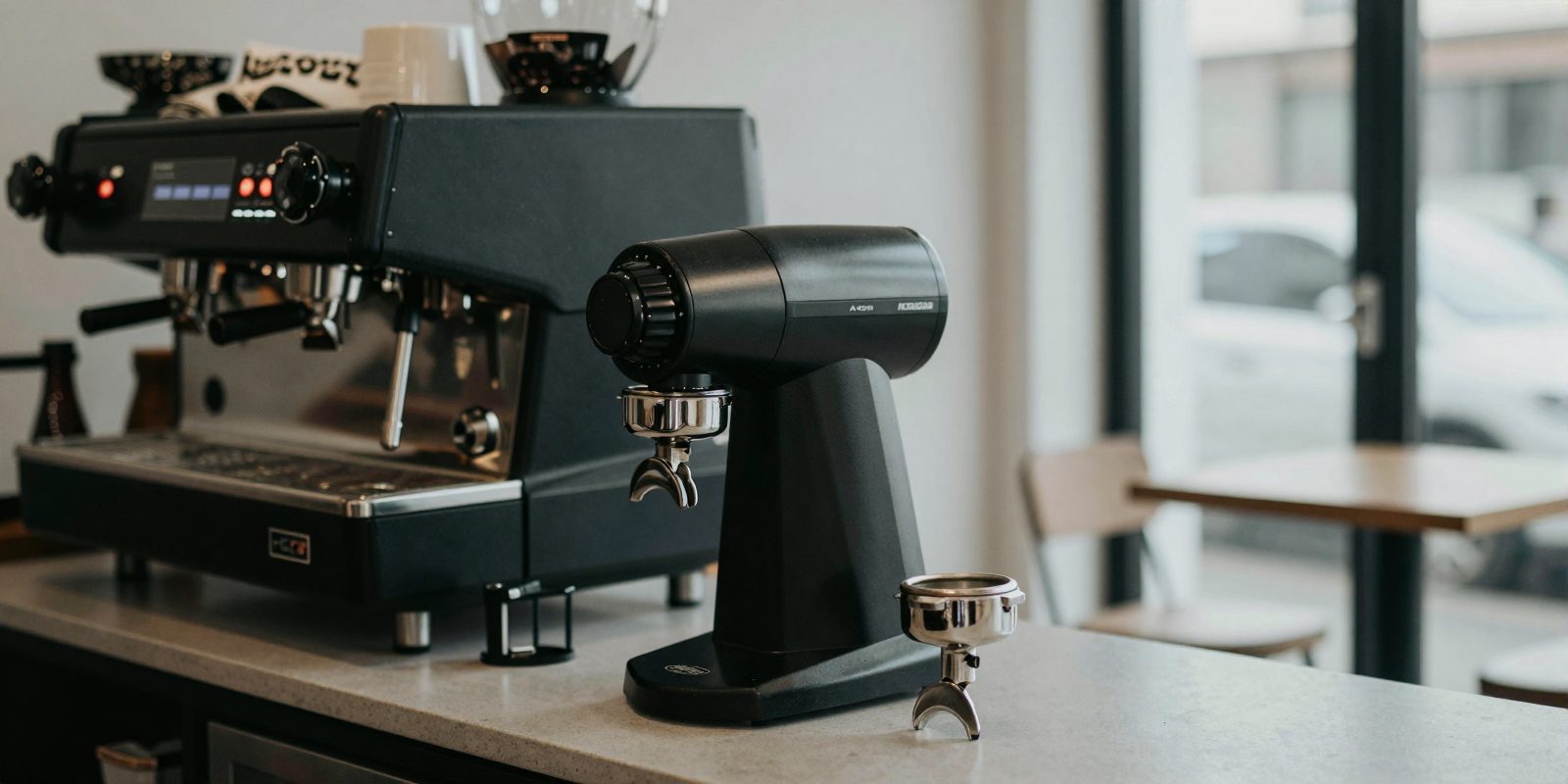
- Portafilter fork and spout. An adjustable fork that holds the portafilter hands-free, and a spout that drops coffee into the centre of the basket, save time and mess.
- Display and controls. Simple controls staff can use without training beat a long menu nobody understands.
- Electrical compliance. Electrical equipment sold in Australia should carry the Regulatory Compliance Mark (RCM). Check for it on the plate, especially on imported grinders bought online.
Buying new, buying used and finance
New grinders come with a warranty, local support and known burr life. Used commercial coffee grinders can be good value, especially older workhorse models with easy parts supply, but check the burrs (or budget for new ones), the motor noise, the hour or dose counter if it has one, and whether a local technician will service it.
Many suppliers offer finance or leasing on coffee equipment, often bundled with the espresso machine. Compare the total paid over the term, what service is included, and what happens to the equipment at the end. Ask for the grinder price as a separate line so you can compare it with buying outright.
Commercial versus home grinders
A home grinder can make excellent espresso, but it is built for a few doses a day. Under café volume its motor and burrs heat up, its retention and dose consistency drift, and its warranty usually does not cover commercial use. If you are deciding for your kitchen, see our guide to the best coffee grinder for home. For a café, buy a grinder rated for commercial work.
Training staff on the grinder
A grinder is only as consistent as the people using it. Show every barista how to check a dose by weight, how far to move the grind adjustment, how to purge after a change, and when to tell the manager something sounds wrong. Write the morning dial-in routine on a card near the grinder so the first shift does it the same way every day.
Signs your grinder needs attention
- Shots get faster week after week at the same setting: the burrs are wearing.
- The grinder sounds strained or slows down under load.
- Clumps or static mess increase, or doses vary by more than a gram.
- The grind shifts finer through the morning and does not come back: cooling may be failing.
- Coffee tastes stale or bitter even with fresh beans: retained coffee and old oils need a deep clean.
Setting up the bench
Where the grinder sits changes how fast the bar runs. Put the main espresso grinder within one step of the group heads, on the side of the machine your barista dosed from in training, with the knock box and tamping station between them. The decaf or second grinder can sit a little further away. Leave room above the hopper to refill it without lifting it off, and check that the bench and the power point can take the grinder's weight and load. A grinder that has to be stretched to, or shares a power board with the machine, slows every coffee you make.
Noise and the customer
Large grinders running on demand all morning are loud. If your café is small or your customers sit close to the bar, compare the noise levels makers quote, ask to hear the grinder running before you buy, and consider a grinder with slower, larger burrs. A rubber mat under the grinder also cuts vibration noise through the bench.
A simple cleaning routine
- Every day: brush out the chute and the fork, wipe the body with a damp cloth, and empty and wipe the hopper if beans sit overnight.
- Every week: run grinder cleaning tablets through the burrs as the maker allows, then purge with coffee until the tablets are gone, and vacuum or brush the burr chamber.
- Every few months: open the burr chamber, clean the burrs and carrier, check for wear, and recalibrate the zero point.
Never wash burrs in water unless the maker says so, and never run rice through a commercial grinder; it is harder on the burrs than coffee and can void the warranty.
Matching the grinder to your espresso machine
A two-group machine at a neighbourhood café rarely needs more than one good espresso grinder plus a decaf grinder. A three-group machine at a busy café, pulling shots on every group at peak, needs a grinder fast enough that the barista never waits for it. Ask your supplier to size the grinder against the machine and your shot count, and if you sell mostly milk coffee with a strong house blend, buy for speed and consistency first.
Pair it with consistent tamping
Once grind and dose are consistent, the tamp is the next variable. Many cafés pair a good on-demand grinder with an automatic tamper.
Common questions
What size burrs does a café grinder need?
It depends on volume. Small cafés often run 54 to 64 mm flat burrs; busy cafés use 75 mm and larger flat burrs or large conical burrs. Check each maker's rated capacity.
Do I need two grinders?
Most cafés keep two: one for the house blend and one for decaf or a single origin. It also gives you a backup if one needs service.
Is grind by weight worth it?
For busy cafés, often yes. It keeps doses consistent through the day without the barista weighing every shot.
How long do grinder burrs last?
Makers quote burr life in kilograms ground, which varies by grinder and coffee. Plan to replace them on the maker's schedule rather than waiting for the coffee to suffer.
Flat or conical burrs for a café?
Both work. Flat burrs are the common choice in Australian cafés and give clarity; large conical burrs run cooler at very high volume and suit milk drinks. Choose on volume and service first.
Should I buy a used commercial grinder?
It can be good value if the model has easy local parts and service. Check the burrs, listen to the motor, and budget for new burrs and a service.
Can one grinder do espresso and filter?
It can, but re-dialling between them wastes coffee and time. Busy cafés use a separate bulk grinder for filter and retail bags.