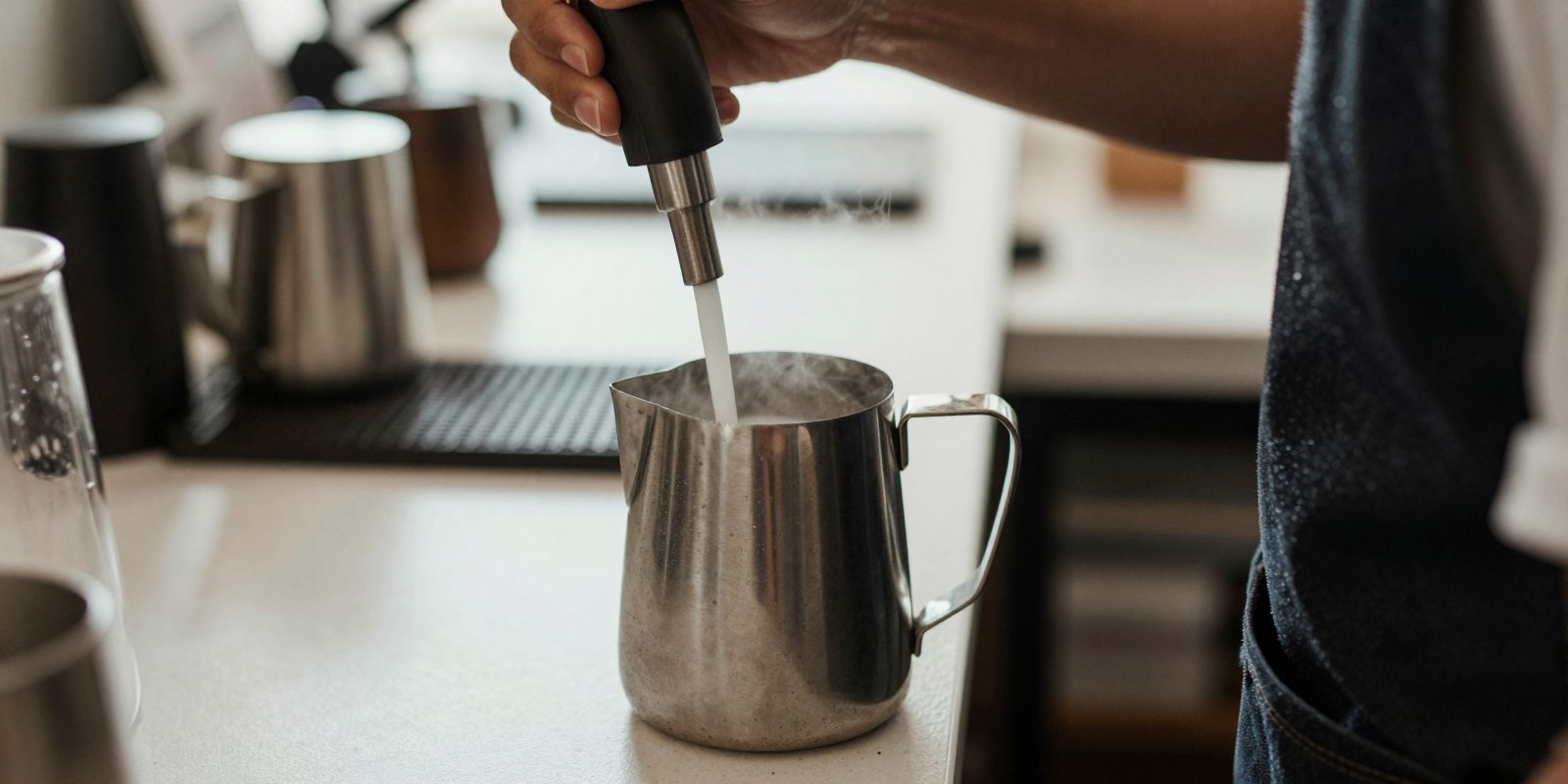
Four ways to steam milk
| Method | Who it suits | Milk quality | Skill needed |
|---|---|---|---|
| Manual steam wand on an espresso machine | Home baristas who want café milk | The best, once learned | High at first |
| Automatic steam wand (set temperature and foam) | Home owners who want it easy | Very good | Low |
| Standalone automatic milk steamer | Busy cafés | Very good and consistent | Low |
| Electric frother jug | Pod and plunger drinkers | Good, airier | None |
Steam wands: learning the real thing
A steam wand blows steam into the milk to heat it and draws in a little air to make foam. Good milk comes from two phases:
- Stretch. With the tip just under the surface, let in air for a few seconds. You will hear a quiet tearing-paper sound. A little air for a flat white, a little more for a latte or cappuccino.
- Spin. Sink the tip slightly and tilt the jug so the milk spins in a whirlpool. This folds the bubbles into fine, glossy microfoam. Stop at about 60 to 65°C, when the jug becomes too hot to hold comfortably.
Tap the jug on the bench to burst any big bubbles, swirl it until it shines like wet paint, and pour.
Automatic steam wands
Some home machines, such as the Breville Bambino Plus, have a wand with a temperature sensor: you choose temperature and foam level, and the machine stretches and stops for you. It is the easiest way to get good milk at home without learning the technique.
Automatic milk steamers for cafés
Standalone automatic steamers sit next to the espresso machine and steam a jug of milk to a recipe while the barista does something else. The best-known, Perfect Moose, describes jugs with an RFID chip that tells the steamer which recipe to run, an infrared sensor that watches the milk temperature, a wand that moves the way a barista's hand would, and a scale under the jug to adjust for how much milk is in it. The appeal for a café is consistency between baristas and freeing up a pair of hands during the morning rush.
What an automatic milk steamer costs to run
Beyond the purchase price, ask whether the model generates its own steam or uses the espresso machine's steam supply. Then check power and water requirements, daily wand and jug cleaning, the maker's scale-maintenance instructions and servicing. Ask the seller which cleaning products it needs and who services it in your city. Lever & Steam does not sell, finance or service these machines.
Milk steamer or milk frother: what is the difference?
The words get mixed up in shops, but they describe two different things.
- A milk steamer heats milk with steam, from a steam wand on an espresso machine or a standalone steaming device. Steam heats the milk and spins it, and done well it makes glossy microfoam you can pour latte art with.
- A milk frother whips air into milk with a spinning whisk or a magnetic disc. An electric milk frother usually heats the milk too, from a heating plate in the base. The foam is airier and stiffer, which suits cappuccinos and hot chocolate better than flat whites.
Some appliances sold as a "milk frother steamer" are really heated frother jugs; they do not use steam at all. If you want café-style milk texture for a flat white or latte, you want steam, or a top induction frother with a fine-foam setting. Our guide to the best milk frother covers frothers in detail.
Types of electric milk frother
| Type | How it works | Best for |
|---|---|---|
| Heated frother jug | Whisk or magnetic disc and a heating plate | Capsule drinkers, cappuccinos, hot chocolate |
| Induction frother | Magnetic whisk and induction heating, often with several foam settings | Finer foam at home, easy cleaning |
| Hand-held whisk | Battery wand you hold in a jug of milk | Cheap, cold foam, travel |
| Capsule machine with built-in frother | A milk jug or wand on the coffee machine | People who want one button |
A hand-held whisk is a nifty gadget used for cold foam and quick drinks, but it does not heat milk and makes big bubbles. It is the cheapest way to try frothy milk, not a replacement for steam.
Which milk steams best
- Full cream milk gives the creamiest, sweetest microfoam and is what most Australian cafés steam by default.
- Skim and light milk foam easily but the foam is dry and big-bubbled; it suits cappuccinos more than flat whites.
- Lactose-free milk steams much like regular milk and tastes slightly sweeter.
- Barista plant milks (oat, soy, almond, macadamia) are made to hold foam and resist splitting in hot coffee. Regular plant milk from the supermarket shelf often turns thin or separates.
Start with cold milk from the fridge and a cold jug. Cold milk gives you more time to texture it before it gets too hot.
Milk texture for each coffee
| Drink | How much air | Foam on top |
|---|---|---|
| Flat white | A little; stretch for a second or two | A thin, velvety layer |
| Latte | A little more | About 1 cm |
| Cappuccino | The most | Thick foam, often with chocolate on top |
| Macchiato | A little | A dollop of foam on the espresso |
| Hot chocolate | Moderate | Light foam, hotter milk is fine |
See flat white vs latte for how these drinks differ in the cup.
Steam power and the steam nozzle
How well a machine steams depends on how much steam it can make and how the steam leaves the wand.
- Steam pressure and boiler size. Dual-boiler and heat-exchanger machines keep steaming for longer and texture milk faster than small thermoblock machines, which can run out of steam on larger jugs.
- Steam tip holes. A one-hole or two-hole tip is gentler and easier to learn on. A three-hole or four-hole steam nozzle delivers more steam, which textures milk quickly but leaves less time to correct mistakes. Many machines include a spare tip so you can choose.
- Wand movement. A wand on a ball joint that swings freely makes positioning the jug easier, especially for left-handers.
Learning without wasting milk
Practise with water and a single drop of dishwashing detergent in the jug. It foams and spins much like milk, so you can learn the stretch and the whirlpool without pouring litres of milk down the sink. Switch to milk once you can make a steady spin and stop at the right moment.
When the milk goes wrong
- Big bubbles on top: the tip was too high or you let air in for too long. Lower the tip sooner, and tap and swirl the jug after steaming.
- Flat milk with no foam: the tip was too deep from the start. Begin with the tip just under the surface so you hear the soft hiss.
- A loud screaming sound: the tip is too deep or the milk is already too hot. Stop and start again with cold milk.
- Milk that separates into foam and liquid: you waited too long to pour. Swirl the jug continuously and pour soon after steaming.
- Milk that tastes cooked: it went over about 70°C. Use a thermometer until you can judge the heat by hand.
Cleaning a steam wand or frother
Purge the steam wand before and after each jug, and wipe it straight away with a damp cloth kept just for that job, so milk never bakes on. Clear the tip holes weekly with the pin supplied. For frother jugs, rinse after every use and wash the whisk and lid in warm soapy water; most induction frother jugs have a removable whisk and a non-stick inside that wipes clean. Our Breville cleaning guide has a step by step for its steam wands.
Hot chocolate, chai and other drinks
A milk steamer is not only for coffee. Steamed milk makes good hot chocolate, chai and turmeric lattes. Add powder or syrup to the jug before steaming so it mixes in as the milk spins, then rinse the wand thoroughly afterwards, because sugar sticks to it. Many electric milk frothers have a hot chocolate setting that heats the milk with less foam.
Getting the temperature right
Most people judge milk by hand: when the jug becomes too hot to hold for more than a second, it is about 60 to 65°C. Until you trust your hand, clip a milk thermometer to the jug or use a jug with a temperature strip on the side.
| Milk temperature | What it tastes like |
|---|---|
| 50 to 55°C | Warm, very sweet; good for children's drinks and a "warm" order |
| 60 to 65°C | The café standard: sweet, creamy, hot enough to drink at once |
| 70°C and over | "Extra hot": less sweet, thinner foam, can taste cooked |
Remember the milk keeps rising a few degrees after you stop, so stop just before your target.
Pouring your first latte art
Latte art needs fresh, glossy microfoam and a good espresso with crema. Hold the cup tilted towards the jug, pour from a little height in a thin stream to sink the milk under the crema, then lower the jug close to the surface and pour faster so the white foam rises on top. A heart is the first shape to learn: pour a white circle, then lift the jug and draw through the middle. It takes many practice cups, so learn on milk you will drink anyway.
Steaming plant milk
Barista plant milks behave a little differently from dairy. Oat milk textures well but can turn thick and gluey if overheated, so stop a little cooler, around 55 to 60°C. Soy milk foams strongly and can split if it meets very acidic coffee; pour it in gently. Almond milk makes lighter foam that fades faster, so pour as soon as you finish. Shake the carton before you pour, because the ingredients settle.
Questions to ask before buying an automatic milk steamer
A café spending real money on a stand-alone milk steaming device should get clear answers to these questions from the seller:
- Does it make its own steam, or does it draw steam from the espresso machine, and will my machine keep up?
- How many recipes can it store, and how do baristas choose one?
- What power point and water connection does it need?
- How long does it take to steam a jug for one, two and three coffees?
- What is the daily cleaning routine, and which cleaning products does it use?
- Who services it in my city, how fast, and is a loan unit available?
- What does the warranty cover, and for how long in commercial use?
Milk steamers for home that are not espresso machines
If you do not own an espresso machine but want better milk, a few options sit between a frother and a café steamer. Some stovetop steamers build pressure on the hob and release it through a small wand. Some induction frothers have a fine-foam setting that gets close to steamed milk. Neither matches a good steam wand, but both beat microwaving milk and whisking it, and both work with a plunger, moka pot or capsule coffee.
Never re-steam milk
It is tempting to top up a half-empty jug and steam it again, but re-steamed milk tastes flat and cooked, and its foam will not hold. Pour leftover milk away, or steam smaller amounts so there is little left. In a café, matching the jug to the order (a small jug for one coffee, a large one for three or four) saves more milk than any gadget. At home, measure the milk into the cup you are about to fill, then pour it into the jug, and you will steam the right amount every time.
Keeping the jug clean
Rinse the jug in cold water straight after pouring, before milk dries in the spout, and wash it in hot soapy water at the end of the day. Dry it upside down. A stainless jug lasts for years; replace it if the spout is dented, because a bent spout ruins latte art.
Which one should you buy?
| If you... | Choose |
|---|---|
| Already own an espresso machine with a wand | Learn the wand; buy a good jug and a thermometer |
| Want café milk with no learning | A machine with an automatic steam wand |
| Use a capsule or plunger and drink cappuccinos | An electric milk frother or induction frother |
| Run a busy café with several baristas | Consider a standalone automatic milk steamer |
| Only want cold foam | A hand-held whisk |
The jug matters more than you think
- Size. Use a jug that will be about a third full: around 350 ml for one flat white, 600 ml for two coffees. Too much milk and it cannot spin; too little and it overheats before it is textured.
- Spout. A sharp, narrow spout pours detailed latte art; a rounder spout pours bigger, simpler shapes.
- Material. Stainless steel, so you can feel the temperature through the side.
Common questions
What is the best way to steam milk at home?
A steam wand on an espresso machine, once learned, gives the best milk. If you do not want to learn, an automatic steam wand or a good electric frother gets you most of the way.
What temperature should steamed milk be?
About 60 to 65°C for most coffees. Hotter milk loses sweetness and texture.
Can you steam plant milk?
Yes. Barista versions of oat, soy and almond milk are made to foam and hold texture like dairy. Regular plant milks often separate.
Are automatic milk steamers worth it for a café?
For busy cafés with several baristas, often yes, for consistency and speed. Weigh the running and servicing costs against the time saved.
Is a milk frother the same as a milk steamer?
No. A steamer heats and textures milk with steam; a frother whips air in with a whisk and usually heats it on a plate. Steam makes finer microfoam.
Which steam tip is easiest to learn on?
A tip with fewer holes, often one or two, gives you more time to position the jug. Four-hole tips are faster but less forgiving.
Can I make hot chocolate with a steam wand?
Yes. Add the powder to the jug first, steam as normal, and rinse the wand well afterwards.