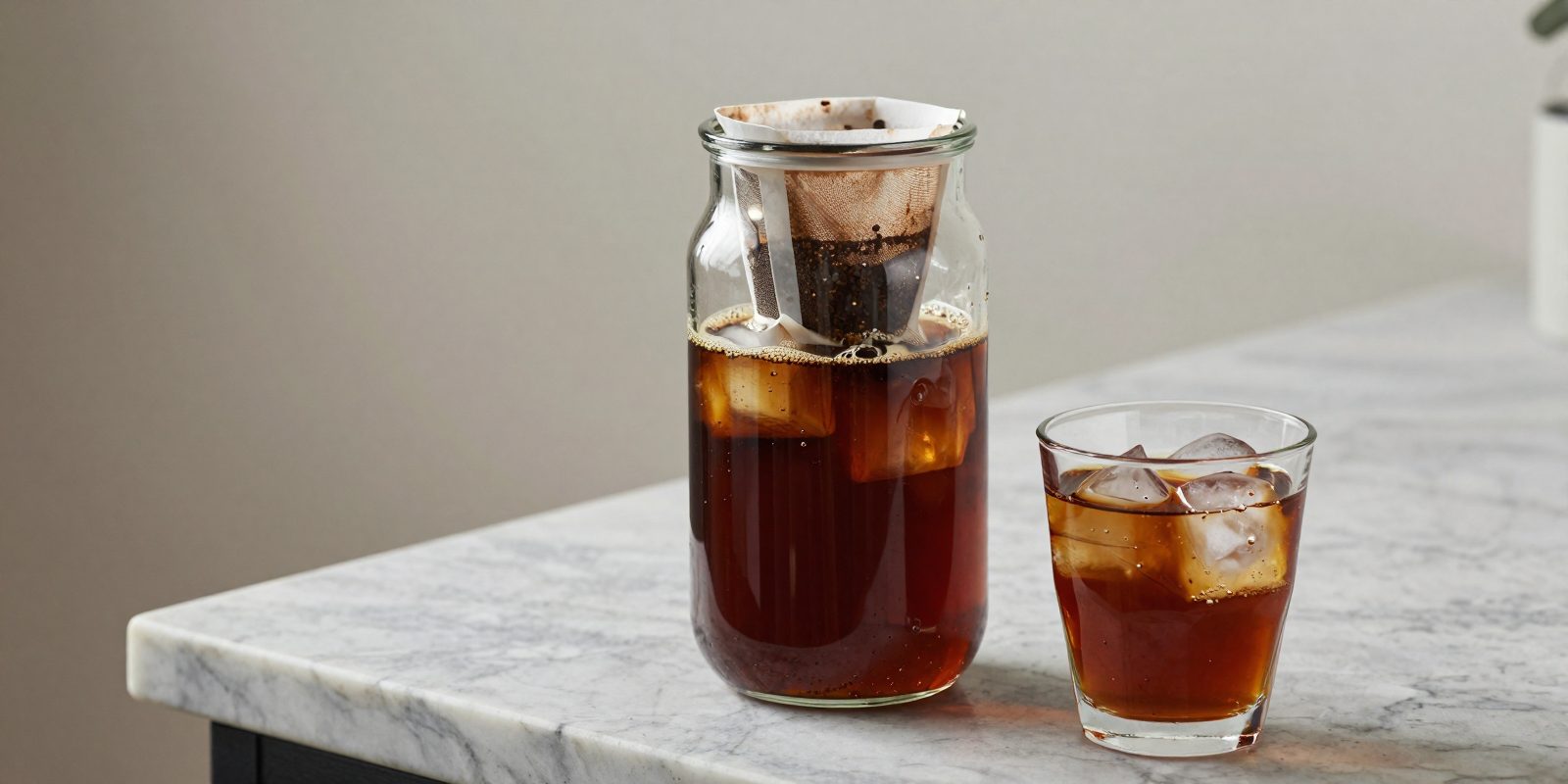
The three kinds
| Kind | Makes | Starting recipe | Steep |
|---|---|---|---|
| Fridge pitcher (e.g. Hario Mizudashi) | Ready to drink | 80 g coffee : 1 L water | 8–24 h, in the fridge |
| Concentrate system (e.g. Toddy) | Concentrate to dilute | 340 g : about 1.9 L | 8–24 h, maker's recipe |
| Slow drip tower | Ready to drink, lighter | Per the maker | Several hours, drop by drop |
Fridge pitchers: the easy start
A glass jug with a fine mesh filter in the middle. Put coarse coffee in the filter, pour water through it, put the lid on and leave it in the fridge overnight. Lift out the filter in the morning and pour. The common starting recipe for a 1-litre pitcher is 80 g of coarsely ground coffee to 1 litre of water, steeped 12 to 14 hours in the fridge. It makes ready-to-drink cold brew that keeps for a few days.
Best for: one or two people who want cold coffee most days with no fuss.
Concentrate systems: for big households and cafés
A large bucket with a felt or paper filter and a plug in the bottom. You steep a lot of coffee in less water, then drain it into a carafe as a concentrate. Toddy's home-model guide uses 340 g of coarse coffee to 1.9 litres of water, steeped for 8 to 24 hours at room temperature, then diluted about 1 part concentrate to 2 parts water or milk. That is the maker's recipe; our fridge-first approach below is a separate choice, and a colder steep may take longer. Concentrate takes less fridge space than the same amount of diluted coffee.
Best for: households that drink a lot of iced coffee, small cafés, and anyone who wants cold brew lattes.
Slow drip towers: the theatre piece
A glass tower drips cold water, one drop at a time, through a bed of coffee into a carafe below, over several hours. The result is lighter and more tea-like than steeped cold brew, and the towers look spectacular on a café counter. They are fragile and slower to clean.
Best for: enthusiasts and cafés that want something to show off.
Grind and beans
Grind coarse, like raw sugar or coarser. Fine grounds make cold brew muddy and hard to filter. Medium and darker roasts give the classic chocolatey cold brew; light roasts can taste thin unless you use more coffee. A burr grinder with a coarse range helps; see our grinder guide.
Cold brew, iced coffee and Japanese iced coffee
Three different drinks get called "cold coffee", and a cold brew maker only makes one of them:
| Drink | How it is made | How it tastes |
|---|---|---|
| Cold brew | Coarse coffee steeped in cold or room-temperature water for many hours, then filtered | Smooth, low in perceived acidity, chocolatey with darker roasts |
| Iced coffee (café style) | Espresso or brewed coffee poured over ice, often with milk and sometimes ice cream | Brighter and more bitter than cold brew; depends on the shot |
| Japanese iced coffee | Hot coffee brewed straight onto ice, so it chills instantly | Keeps more of the coffee's aroma and acidity |
If you want a drink quickly on a hot afternoon, Japanese iced coffee or a shot over ice needs no overnight wait. Cold brew rewards planning: make it once and drink it over several days.
The ratios, worked out
The two makers' starting recipes in the table above are very different strengths, and knowing why helps you adjust them:
| Recipe | Coffee | Water | Ratio | Served |
|---|---|---|---|---|
| Fridge pitcher (Hario's published recipe) | 80 g | 1 litre | about 1:12.5 | As it is, over ice |
| Concentrate (Toddy's home recipe) | 340 g | about 1.9 litres | about 1:5.6 | Diluted, usually about half and half or more |
A concentrate made at 1:5.6 and diluted one part concentrate to one part water or milk ends up around 1:11, close to the pitcher's strength. The concentrate simply stores in less space and lets each person choose how strong to make their glass.
To scale either recipe, keep the ratio and change both numbers: half the coffee needs half the water.
Making it in a fridge pitcher, step by step
- Grind the coffee coarse, like raw sugar.
- Fill the mesh filter with the coffee and sit it in the jug.
- Pour cold, filtered water slowly over the coffee so it all gets wet.
- Stir gently if the grounds float dry, put the lid on and refrigerate.
- After 8 to 24 hours, lift the filter out and let it drain into the jug.
- Pour over ice, add milk if you like, and keep the jug covered in the fridge.
Making a concentrate, step by step
- Put the filter in place and the plug in the base of the brewer.
- Add water and coarse coffee in layers, as the maker's guide describes, so all the grounds get wet.
- Leave it to steep for the maker's recommended time, usually between 8 and 24 hours.
- Pull the plug and let the concentrate drain into the carafe.
- Store the concentrate covered in the fridge and dilute each glass to taste.
Without a maker: the jar method
A clean jar and a filter will do. Steep coarse coffee in water at about the pitcher ratio, roughly 1:12, in the fridge overnight. Strain it first through a fine sieve to catch the grounds, then through a paper coffee filter or a clean cloth to remove the fine sediment. It is messier than a pitcher, but it costs nothing and shows whether you like cold brew before you buy anything.
What to look for in a cold brew maker
- Capacity. A one-litre pitcher suits one or two people; concentrate systems suit households that go through a lot.
- Filter type. Fine mesh is reusable but lets through some sediment; paper and felt filters give a cleaner cup but need replacing.
- Material. Glass does not hold flavours or smells; if it is plastic, check what it is made of and how it is cleaned.
- Fridge fit. Measure the fridge door or shelf height before you buy a tall jug.
- Cleaning. Wide openings and dishwasher-safe parts make the daily job easier.
- Spare parts. Replacement filters and seals should be easy to buy.
When cold brew goes wrong
| What you notice | Likely cause | Try |
|---|---|---|
| Bitter or harsh | Steeped too long, or ground too fine | Shorten the steep or grind coarser |
| Weak or watery | Too little coffee or too short a steep | Use more coffee or steep longer |
| Muddy, with sludge in the glass | Grind too fine, or the filter is too coarse | Grind coarser; filter again through paper |
| Sour or flat | Very light roast or stale beans | Try a medium or darker roast, freshly roasted |
| Tastes stale after a few days | Stored too long, or uncovered | Make smaller batches and keep them covered |
Why cold water makes different coffee
Hot water dissolves the flavour compounds in coffee in a few minutes. Cold water dissolves them far more slowly, which is why cold brew needs hours rather than minutes. Time makes up for temperature, but not exactly: some compounds that hot water pulls out readily, including many of the aromatic and acidic ones, come out less in cold water. The result is the smooth, rounder, less sharp cup that people like cold brew for, and also the reason it can taste flat with very light, fruity roasts.
The practical lessons:
- Steep time is your main control. Shorter is lighter and brighter; longer is heavier and, past a point, woody and bitter.
- Grind size is the second. Coarse grounds extract evenly over a long steep; fine grounds over-extract and clog the filter.
- Temperature matters too. Fridge steeps are slower than room-temperature steeps, so allow the longer end of the time range.
Making cold brew for a crowd or a café
Concentrate scales well, and a little arithmetic tells you how much coffee to buy. The grounds hold back some water, roughly twice their own weight, so you get out less than you put in.
| Coffee | Water at 1:5.6 | Concentrate out, roughly | Glasses at 1:1 dilution, 250 ml each |
|---|---|---|---|
| 340 g | about 1.9 litres | about 1.2 litres | about 9 |
| 500 g | about 2.8 litres | about 1.8 litres | about 14 |
| 1 kg | about 5.6 litres | about 3.6 litres | about 28 |
Our arithmetic from Toddy's published home ratio, assuming the grounds retain about twice their weight in water. Your yield will vary with the grind and filter.
For a café, check your food safety plan covers how cold brew is made, labelled with the date and stored cold, and how long it is kept before it is thrown out.
Drinks to make with it
- Cold brew on ice. The simplest: pitcher-strength cold brew over plenty of ice.
- Cold brew latte. One part concentrate to one or two parts cold milk, over ice.
- Cold brew and tonic. Concentrate poured slowly over tonic water and ice, with a strip of orange peel.
- Sweetened cold brew. Dissolve sugar in a little hot water first to make a syrup, because sugar does not dissolve well in cold coffee.
- Coffee ice cubes. Freeze cold brew in a tray, so the ice does not water the drink down as it melts.
Storing it
Keep cold brew covered in the fridge, and make batches you will finish within a few days, as the makers' guides and food safety advice suggest. It loses its fresh taste over time even when it is safe. Store concentrate and diluted coffee separately: once milk is added, treat it like any other milk drink and keep it cold.
Cleaning a cold brew maker
Rinse the filter and jug as soon as you empty them, before the grounds dry onto the mesh. Wash with warm, soapy water and a soft brush, and rinse well so no detergent taste carries into the next batch. Felt filters in concentrate systems need rinsing in clean water only, stored damp in the fridge as the maker directs, and replacing regularly. Check seals and lids for trapped grounds, which can turn mouldy.
Fast and electric cold brew makers
Some electric makers claim cold brew in a fraction of the usual time, using circulation, vacuum or agitation to speed up extraction. They are convenient when you forget to start a batch overnight. Expect a slightly different taste from a long, still steep, and check how easy the parts are to clean, because more parts mean more places for old coffee to hide.
The three kinds, side by side
| Fridge pitcher | Concentrate system | Slow drip tower | |
|---|---|---|---|
| Typical capacity | About 1 litre | 1 to 2 litres of concentrate, more for café models | Small batches |
| Filter | Fine mesh, reusable | Felt or paper | Paper or cloth, plus a valve for the drip |
| Effort | Fill, wait, lift out the filter | Layer, wait, drain, dilute | Set the drip rate, watch it |
| Bench or fridge space | Fits a fridge door | Needs bench space while steeping | Tall, stays on the bench |
| Cleaning | Easy | Moderate; felt filters need care | The most parts |
| Taste | Smooth, ready to drink | Strong, adjustable by dilution | Lighter, more tea-like |
| Best for | Daily drinkers at home | Big households, offices, cafés | Enthusiasts and display |
Choosing beans for cold brew
- Roast. Medium to dark roasts give the chocolate and caramel flavours most people expect. Light roasts can be lovely but need a longer steep or a stronger ratio, and can taste thin.
- Blends or single origins. Many roasters sell a cold brew blend designed for the method; a Brazil or Colombia single origin is a safe start if you prefer one origin.
- Freshness. Use beans roasted within the last few weeks. Old beans make flat cold brew just as they make flat espresso.
- Grind at home if you can. If not, ask the roaster to grind for cold brew or plunger, which is coarse.
Water
Coffee is mostly water, so water that tastes good on its own makes better cold brew. If your tap water tastes of chlorine, use a filter jug, or let tap water stand in an open jug for a while before brewing. Keep it cold if you are steeping in the fridge from the start.
Mistakes to avoid
- Grinding too fine, the most common cause of bitter, muddy cold brew.
- Not wetting all the grounds, which leaves dry pockets that extract nothing.
- Steeping on the bench in a hot kitchen, when the fridge is simpler and safer.
- Squeezing the filter to get the last drops, which pushes bitter fines into the coffee.
- Leaving it too long in the fridge before drinking, so it tastes stale.
- Diluting concentrate by guesswork every time; measure once until you find your ratio.
How much caffeine is in cold brew?
It depends almost entirely on how much coffee you use and how much you drink. A glass of pitcher-strength cold brew can be similar to a cup of filter coffee, while a glass of undiluted concentrate can hold far more. If you are watching your caffeine, dilute concentrate generously and keep track of how many glasses you have in a day.
The designs you will see in Australian shops
You will meet the same handful of designs again and again when you shop for a cold brew coffee maker. Knowing how each one works matters more than the brand on the box.
- Toddy-style concentrate brewers. A tub with a felt filter and a rubber stopper in the base. You fill it with coarse coffee and water, wait 12 to 24 hours, pull the stopper and let the concentrate drain into a glass carafe. The Toddy cold brew system made this shape famous, and it is still the go-to for a week's worth of smooth coffee concentrate at home or in a small café.
- Filtron-style concentrate brewers. Very similar idea: a brewing container that sits over a carafe, with a paper or felt filter, made for large batches of concentrate. If you see "Filtron cold water coffee concentrate brewer" on a shelf, it belongs in this family.
- OXO Brew and other "rainmaker" brewers. OXO's design has a perforated lid that spreads the water evenly over the grounds, so you do not have to stir. A switch on the stand drains the concentrate when the time is up. It suits people who want less mess than an open tub.
- Hario and other fridge pitchers. The Hario cold brew pitcher is the classic immersion jug: a tall glass bottle with a fine mesh filter basket down the middle. Fill the basket, fill the jug, put it in the fridge, lift the basket out the next day. It is the simplest way to make cold brew coffee at home.
- Glass cold brew coffee makers with a stainless filter. Many generic pitchers copy the Hario idea in borosilicate glass with a steel mesh. Look for a wide neck you can get a hand or a brush into.
- Bruer and other slow drip systems. A cold drip coffee maker drips water through a bed of coffee one drop at a time, controlled by a small valve. The Bruer is a compact example; tall tower makers are the café showpiece. Cold drip coffee is lighter and closer to tea than immersion cold brew.
- Large keg and bag systems. Café and office cold brewers steep several litres at once in a big mesh bag inside a tub or keg, sometimes ready to pour as nitro. They make sense when you sell or serve cold brew every day, not for a household.
Matching a maker to how you drink coffee
| If you... | Look at |
|---|---|
| Want one glass a day, with milk | A 1 litre fridge pitcher |
| Make iced lattes for a family | A concentrate brewer and dilute each glass |
| Hate washing up | A pitcher with a fine stainless or plastic mesh basket |
| Want the lightest, clearest flavour | A slow drip tower or a compact drip system |
| Run a café, office or market stall | A large batch concentrate system or a keg setup |
| Travel or camp often | A plastic pitcher or a bottle with an infuser, no glass |
Cold brew and the rest of your gear
A cold brew maker works best alongside the coffee gear you already own. A burr grinder that can go coarse is the most useful partner, because blade grinders make a mix of dust and chunks that clogs filters. Your kettle is not needed at all, which is one of the joys of the method. If you already have an espresso machine, cold brew is a good second drink for hot days, not a replacement: espresso over ice tastes brighter and more bitter, while cold brew tastes rounder and sweeter.
Is it worth buying a cold brew coffee maker?
If you drink cold coffee a few times a week, yes. A cheap pitcher pays for itself quickly against café cold brew, and it takes about five minutes of work a batch. If you only want iced coffee now and then, a large jar and a sieve lined with a paper filter will do the job, and you can buy a dedicated cold brewer later if you find you love it.
Serving cold brew through the week
Once a batch is made, a little planning makes it last. Pour concentrate into a clean glass bottle with a tight lid rather than leaving it in the brewer, so it takes up less fridge space and stays fresher. Label it with the date you made it. Dilute only what you are about to drink, because diluted cold brew loses its flavour faster than concentrate. For a cold coffee on the go, fill a travel bottle with ice, concentrate and milk in the morning. If a batch is near the end of its life, freeze it in an ice cube tray: coffee ice cubes keep iced coffee strong as they melt, instead of watering it down.
Keeping it safe
Steeping in the fridge is the simplest way to keep cold brew out of the temperature range where bacteria grow quickly. Food Standards Australia New Zealand describes 5°C to 60°C as the temperature danger zone. Keep finished cold brew covered in the fridge, use clean equipment, and drink it within a few days.
Common questions
What is the best cold brew coffee maker?
For most homes, a fridge pitcher such as the Hario Mizudashi: cheap, simple and easy to clean. For large quantities, a concentrate system.
Is cold brew stronger than regular coffee?
Concentrate is intended to be diluted. Flavour strength and caffeine are different questions: coffee dose, beans, serving size and dilution all matter. Cold brewing alone does not tell you whether a drink has more or less caffeine than hot coffee.
How long does cold brew last?
Keep it covered in the fridge and make small batches you can use within a few days. Toddy gives a longer refrigerated storage period for its specific concentrate recipe; do not apply that to every homemade batch, especially after adding milk.
Can I make cold brew without a special maker?
Yes. Steep coarse coffee in a jar of water in the fridge overnight, then strain through a paper filter or fine cloth.
What grind is best for cold brew?
Coarse, like raw sugar or coarser. Fine grounds over-extract and make the coffee muddy and hard to filter.
What is the ratio for cold brew coffee?
For a ready-to-drink pitcher, Hario's published recipe is 80 g of coffee to 1 litre of water, about 1:12.5. For a concentrate, Toddy's home recipe is 340 g to about 1.9 litres, about 1:5.6, diluted to serve.
Can I make cold brew at room temperature?
Many recipes steep at room temperature, but steeping in the fridge keeps it out of the temperature range where bacteria grow quickly, which is the simpler and safer choice at home.
Is cold brew less acidic?
It is usually perceived as smoother and less acidic than hot coffee, because cold water extracts the coffee differently. The beans and roast still make a big difference.
Can I use espresso beans for cold brew?
Yes. Medium and darker roasts often sold for espresso suit cold brew well; just grind them coarse.
How long should cold brew steep?
Most makers' guides give 8 to 24 hours. Start in the middle, around 12 to 16 hours in the fridge, then shorten it for a lighter taste or lengthen it for a stronger one.
Can I heat up cold brew?
Yes. Some people warm diluted concentrate for a smooth, low-acidity hot coffee, but it will taste different from coffee brewed hot.
How much coffee do I need for cold brew?
For a one-litre fridge pitcher, about 80 g by Hario's published recipe. For concentrate at Toddy's home ratio, 340 g of coffee makes about 1.2 litres.
Why is my cold brew cloudy?
Fine particles from the grind pass through mesh filters. Filter it again through paper, or grind coarser next time.
Is cold brew the same as iced coffee?
No. Cold brew is steeped cold for hours; café iced coffee is usually espresso or brewed coffee poured over ice, often with milk.
Should I dilute cold brew?
Concentrate, yes, usually about one part to one part water or milk to start. Pitcher-strength cold brew is made to drink as it is.
Can cold brew be made with decaf?
Yes. Decaffeinated beans work the same way; use a medium or darker roast for the classic flavour.